

When running uphill or pedaling at high intensity, your legs start to burn and your breathing turns shallow and rapid. Most people assume that their endurance limit is set by their heart or lung capacity. In reality, the lungs are simply two passive sacs filled with airways. They have no muscle tissue of their own to expand or contract independently. Moving air in and out relies entirely on a dedicated group of muscles that function like an old blacksmith's bellows.
If these muscles fatigue quickly, the entire body is forced to slow down to protect breathing. This is precisely where targeted inspiratory muscle training comes in, a method known internationally as Inspiratory Muscle Training (IMT). Rather than letting these muscles work passively in the shadow of general aerobic exercise, we subject them to structured strength training, much like working legs or back at the gym.
Can the muscles that inflate the lungs actually get stronger?
To answer this question, we need to look at the nature of the tissues involved in inhalation. The primary inspiratory muscle is the diaphragm, a large dome-shaped muscle separating the chest cavity from the abdominal cavity. Working alongside it are the external intercostal muscles located between the ribs, as well as accessory neck muscles such as the scalenes and sternocleidomastoid. All of these are skeletal muscles. They are made of the same slow-twitch and fast-twitch muscle fibers found in the biceps or quadriceps.
Because they are skeletal muscles, they follow the same biological laws of adaptation. When a skeletal muscle faces a mechanical load heavier than what it is accustomed to, it is forced to adapt. At a cellular level, this means an increase in muscle fiber thickness (hypertrophy) and improved neuromuscular recruitment, which is the brain's ability to send stronger, better-coordinated electrical signals to contract them.
At normal rest, the diaphragm contracts about 12 to 16 times per minute without strain. Even during a run, the resistance air encounters in the airways remains relatively low. Running alone therefore provides an endurance stimulus, but rarely a maximal strength stimulus for the diaphragm. To build inspiratory muscle strength, an external barrier is needed that forces these muscles to generate higher pressure with every breath.
How a breathing resistance device works
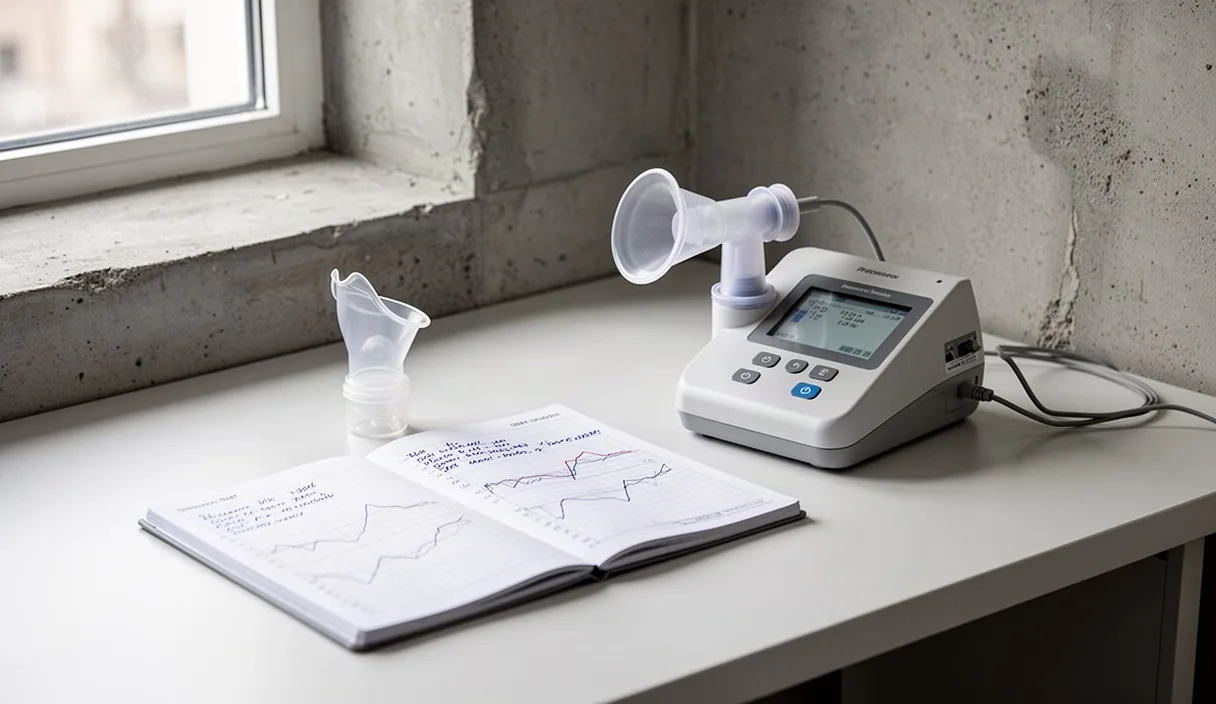
A breathing trainer is a compact, portable device placed in the mouth. Instead of allowing air to flow freely, it introduces a mechanism that restricts airflow or requires a specific pressure threshold to open. The simplest everyday comparison is drinking through a straw: if you try to drink water through a wide straw, you feel no fatigue. If you try to pull a thick frozen shake through a narrow straw, your cheeks and diaphragm have to work much harder to generate the required suction.
There are two primary types of mechanisms in these devices, with distinct functional differences:
| Feature | Flow-dependent resistance devices | Pressure threshold devices |
|---|---|---|
| Mechanism | Narrows the diameter of an aperture through which air passes. | Uses a calibrated spring that holds a valve closed. |
| Effort dependence | If you inhale slowly, resistance drops significantly. | The valve does not open at all unless the preset pressure is reached. |
| Training consistency | Varies depending on the rate of inhalation. | Constant resistance across the entire range of motion. |
| Primary use | Basic respiratory conditioning and relaxation. | Targeted athletic training and clinical rehabilitation. |
With pressure threshold devices, the user seals their lips around the mouthpiece, wears a nose clip to prevent breathing through the nostrils, and inhales forcefully. The internal spring creates resistance. Only when the inspiratory muscles produce sufficient negative pressure within the chest cavity does the valve open, allowing air to enter. As strength builds, the spring tension can be adjusted to higher levels, adhering directly to the principle of progressive overload.
The respiratory metaboreflex phenomenon in sports
What happens when the breathing muscles tire in the middle of a race? This is where a compelling survival mechanism of the human body comes into play, known as the respiratory metaboreflex. The body operates on a strict hierarchy of priorities: breathing and heart function always take precedence over movement in the arms and legs.
When you run at an intensity above 80% of VO2 max, the diaphragm consumes a significant portion of the total oxygen circulating in the blood. If the diaphragm starts to fatigue, acidic metabolic byproducts such as hydrogen ions and lactate accumulate within it. Specialized sensors inside the muscle (type IV nerve fiber chemoreceptors) detect this buildup and send a distress signal to the central nervous system.
The brain reacts immediately through the sympathetic nervous system. It triggers vasoconstriction, or the narrowing of blood vessels, in working limbs such as the thighs and calves. Put simply, the body "steals" oxygenated blood from the legs and redirects it to the diaphragm to prevent respiratory failure. As a result, the legs suddenly feel heavy, burn, and fail to sustain their pace, not because the legs themselves are exhausted, but because the diaphragm is.
By strengthening the inspiratory muscles through resistance training, we delay their fatigue. A stronger diaphragm generates the same mechanical pressure with less relative effort, accumulates metabolites much more slowly, and therefore avoids prematurely triggering the metaboreflex. Blood continues to flow freely to the legs, allowing the athlete to sustain speed for longer periods.
Basic training protocol with a resistance device
Inspiratory muscle training does not require hours of practice. On the contrary, it works best with short, highly targeted sessions. The most extensively researched scientific protocol relies on a simple rule: 30 dynamic inhalations, twice a day.
To apply the protocol correctly, follow the steps below:
- Adjusting body posture: Sit on a chair with your back straight and shoulders relaxed. Avoid slouching, as this compresses the abdomen and prevents the diaphragm from descending fully.
- Positioning the equipment: Place the nose clip on your nose to ensure no air enters through it. Place the mouthpiece into your mouth and seal your lips firmly around it to prevent leaks.
- Full exhalation: Exhale slowly and calmly until your lungs are completely emptied of residual air. Exhalation should be free, without resistance.
- Explosive inhalation: Inhale as forcefully and quickly as possible through the device, aiming to fill your lungs completely within about 2 seconds. Focus on pushing the abdomen outward rather than lifting your shoulders.
- Repeating the cycle: Perform 30 such consecutive inhalations. The entire session usually takes less than 5 minutes.
The device intensity should be set at approximately 50% to 60% of maximum inspiratory pressure (PImax). In practical terms, this means the resistance should be challenging enough that during the final 5 breaths (from the 26th to the 30th) you feel close to your effort limit. If you complete all 30 breaths comfortably, slightly tighten the valve for the next day. The program is ideally performed 6 days a week, morning and afternoon, for a period of 6 to 8 weeks.
Athletes who truly benefit
Respiratory muscle training does not deliver identical gains across every type of exercise. A weightlifter or a 60-meter sprinter is not limited by diaphragm fatigue, since their efforts last only a few seconds. The benefit is noticeable in sports where breathing is under strain for prolonged periods or where body posture mechanically restricts thoracic function.
- Road cyclists and triathletes: When the cyclist is in an aerodynamic position (hunched over the handlebars), the hips press against the abdominal region. This mechanical compression hinders the descent of the diaphragm. A stronger diaphragm can overcome this external pressure and continue to adequately ventilate the lungs without unnecessary fatigue.
- Middle- and long-distance runners: In races from 5 kilometers to marathons, maintaining a steady pace directly depends on delaying the respiratory metaboreflex. Runners who train their inhalation often report a lower rate of perceived exertion at the same running speed.
- Swimmers: In swimming, the hydrostatic pressure of the water exerts constant force on the chest, compressing it. Furthermore, the swimmer can only inhale at specific moments during torso rotation. The ability to inhale a large volume of air in fractions of a second against water pressure offers a decisive advantage.
- Rowers: Rowing demands enormous muscular power from the core, while the body folds completely at the catch of each stroke. In this case, the diaphragm serves a dual purpose: stabilizing the spine while exchanging gases, often leading to premature respiratory exhaustion.
Common execution mistakes
The most common mistake is shallow breathing from the upper chest. Many users, trying to overcome the resistance, shrug their shoulders and strain their neck, leaving the abdomen stationary. This engages almost exclusively the accessory muscles while the diaphragm remains underutilized. The movement must originate deep from the diaphragm, pushing the abdomen outward and the ribs sideways.
A second mistake is rushing to increase the resistance too quickly. If the spring is tightened more than it should be, the athlete fails to complete the full range of inhalation, producing an abrupt, truncated effort that fills only a third of the lungs. The resistance is set correctly only when it allows a full, deep inhalation, even if it requires substantial effort.
Finally, many overlook the speed of movement. Slow, dragging inhalation through the device does not train the fast-twitch muscle fibers needed during intense exercise. The inhalation must be dynamic and explosive right from the first millisecond.
Next practical steps for safe implementation
If you decide to include inspiratory muscle training in your routine, start by choosing a reliable pressure threshold device that features a clear adjustment scale in centimeters of water (cmH2O). For the first three to four days, use a very low resistance to get used to the diaphragmatic movement and avoid potential chest muscle soreness.
Schedule your sessions at consistent times throughout your day, such as right after waking up in the morning and before dinner. Avoid performing the protocol right before a demanding running or cycling workout, as your respiratory muscles will already be fatigued before you even start the main session.
Although the method is safe for healthy individuals, people with a history of spontaneous pneumothorax, recent eye surgeries, cardiovascular conditions, or active asthma should definitely consult their pulmonologist or primary physician before starting. Guidance from a qualified respiratory physiotherapist or coach can also ensure your technique is sound, protecting you from unnecessary strain.